Mapping Prepositions: English - German
Word by word
As a new German language learner I often struggle a lot with direct translation... as one of the only tools I have to at least make a rudimentary attempt at understanding the language.
I used to get really confused really fast and I think most beginner learners do... You type a word in Google Translate... it gives some meaning... and then you just find it used differently elsewhere. Maybe too differently sometimes.
It starts simply
Early on I tried to learn German prepositions... and as any avid Google Translate user, I went to it wanting to know what "an" means.
I see the first meaning "to" that works. "Er geht an die Tafel" aha! It works. Next!
"Das Bild hängt an der Wand." Not quite... the picture hängt to? the wall? Google translates it "on the wall"... that's different.
"Ich glaube an dich" — Google Translate gives me this as "I believe in you." What? First to... then on... and now in?
Through a lot of trial, error, seeing a lot of examples... "an" actually doesn't mean "on" or "in" a lot of the time... sometimes not even "to."
This word for word translation doesn't really land and is missing something.
Rebuilding
I was wrong and I need a broader way of thinking about this.
I look at a lot of examples of "an" and the rest of the words Google Translate listed: on, against, along. A lot, but... carries some sense of towardness I guess? Contact, direction. I can work with that. I move on with my newly discovered meaning of "an."
It falls apart again
Later on I meet "denken an" for the first time and I put it into Google Translate. It spits out "thinking of."
What? "Of"?
I remove "denken" from the sentence and it translates "an" as "to." Again. "Of" doesn't mean "to." Or "at." Or any sense of towardness. What is going on?
The Problem
Word to word mapping is broken. It doesn't work! What I am describing is a problem a lot of new language learners hit. The words don't map exactly in translation.
My expectation when learning a new language is: I will find a counterpart to this specific word or words I have, and I will stack them together and it will work out.
It almost never did.
Exploration
Trying again
I move on to a different preposition. This time: "von." Google Translate gives me a few... from, of, by, out of.
I don't try to map again. I just try to consolidate all the meanings and arrive at maybe three good ones.
From... or a source Ich komme von der Arbeit.
Of... possessive Das ist das Auto von meinem Bruder.
By (agent in passive constructions) Das Buch wurde von Goethe geschrieben.
Good enough, I guess.
I notice...
The distinct meanings "von" can carry... almost abstract meanings... that can be reached from within German with "von."
I can reach the same abstract meanings from English using "from," "of," and "by." Interesting.
I find a lot of examples of "von." Slightly different maybe, but I am convinced I can move on. It's a good way to understand it.
The Layers
Something in the "von" exploration caught me... the almost abstract meanings below it all.
It almost feels like a map — a map between semantic meanings and language-specific prepositions.
A map that, if I charted it, I would understand how to use these prepositions.
One semantic layer carries the abstract concepts: source, agency, possessiveness, towardness, location, spatial directions, points...
Each language should have its own layer that contains its own prepositions, mapping to these abstract semantics. "von" → source, agency, possession. "an" → towardness, direction... for German. English is similar: "of" → source, "by" → location, agency... etc.
I asked Weyse to build this. and it built the following map:
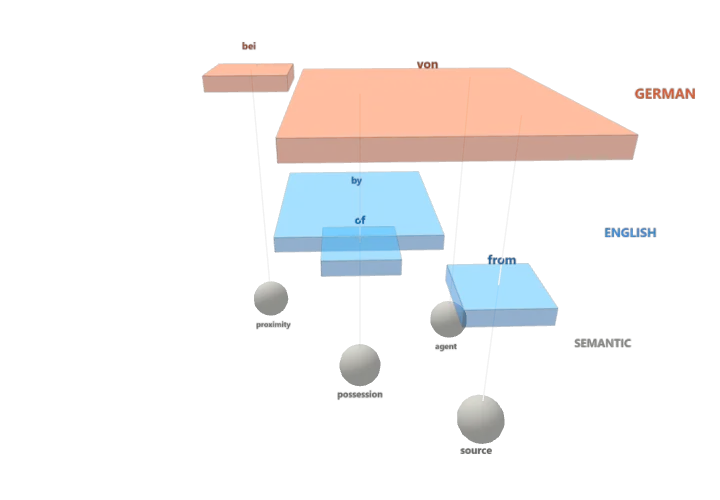
Weyse charted "borders" how each preposition maps to certain concepts.
Each language has its own preposition border layer.
When stacked, one can see how the areas of "from," "of," and "by" all fall under "von" (partially).
Beyond the Layers
Even after we construct the map... some things just don't fall in place.
Like our earlier example "denken an," which Google Translate tells me is "thinking of/about."
Do I need to revise my map?
I find new examples...
- sich erinnern an — to remember
- glauben an — to believe in
- sich gewöhnen an — to get used to
- sich wenden an — to turn to someone
I need a new lens to think of "an."
I try to tie them to that towardness, direction abstract I caught from it...
sich erinnern an — to remember (your memory reaches toward something)
glauben an — to believe in (your faith is directed at something)
sich gewöhnen an — to get used to (you're adjusting yourself toward something)
sich wenden an — to turn to someone (you direct yourself at them)
And "denken an" can fit that frame.
"Denken an" — they're not saying "I'm thinking about you." It's closer to "my thoughts are reaching toward you."
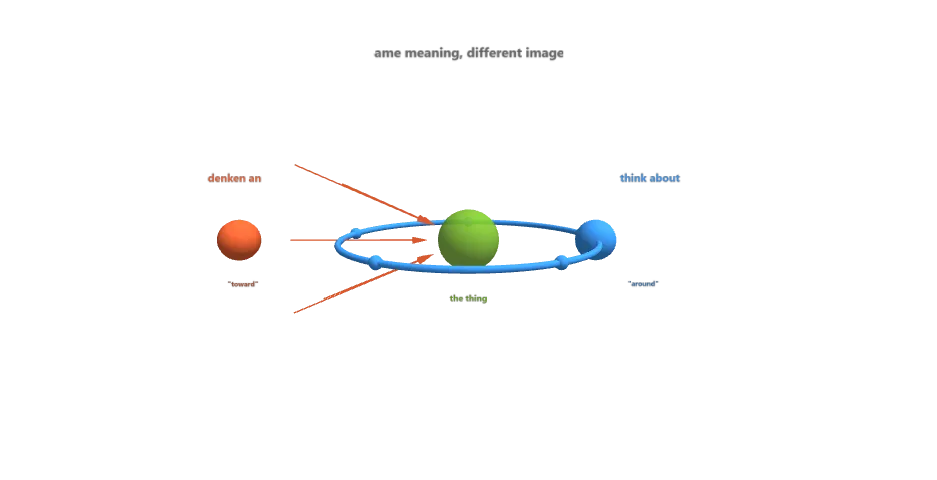
Which means I don't need to revise the map?
For some examples, both languages are just inherently saying different things, using different metaphors.
And trying to translate it, we just tend to find the closest metaphor in another language. Or at least Google Translate does.
Some differences aren't about mapping words. They're about different images entirely.
German and English aren't mapping the same concept differently — they're starting from different spatial ideas.
Going full circle
In my preposition understanding attempt I found some of the differences between English and German and found a way I can work through understanding the image German sees.
For one or more languages:
Find many examples of some preposition.
Reduce it down to some abstract semantic that is consistent throughout the examples.
Map language layers to semantic ones.
Which resulted in this map (a work in progress):
What's next?
Some differences are about different images entirely. German and English aren't mapping the same concept differently — they're starting from different spatial ideas.
Translation is lossy... and is not accurate most of the time. Accurate as in... if you dig deep enough, most translations carry different underlying ways of saying very similar things. Each language embodies almost a way to see the world of its own.
Maybe what I try to highlight in this article will evolve into my way of understanding different concepts in both languages... not just prepositions... maybe tenses, verbs, and more.
If you're someone who speaks both languages and finds this interesting, don't hesitate to reach out!
Contributors
This post was written with the help of Weyse — a Claude instance named after the German verb weisen (to show, to point). Me learning German, Weyse learning to show.